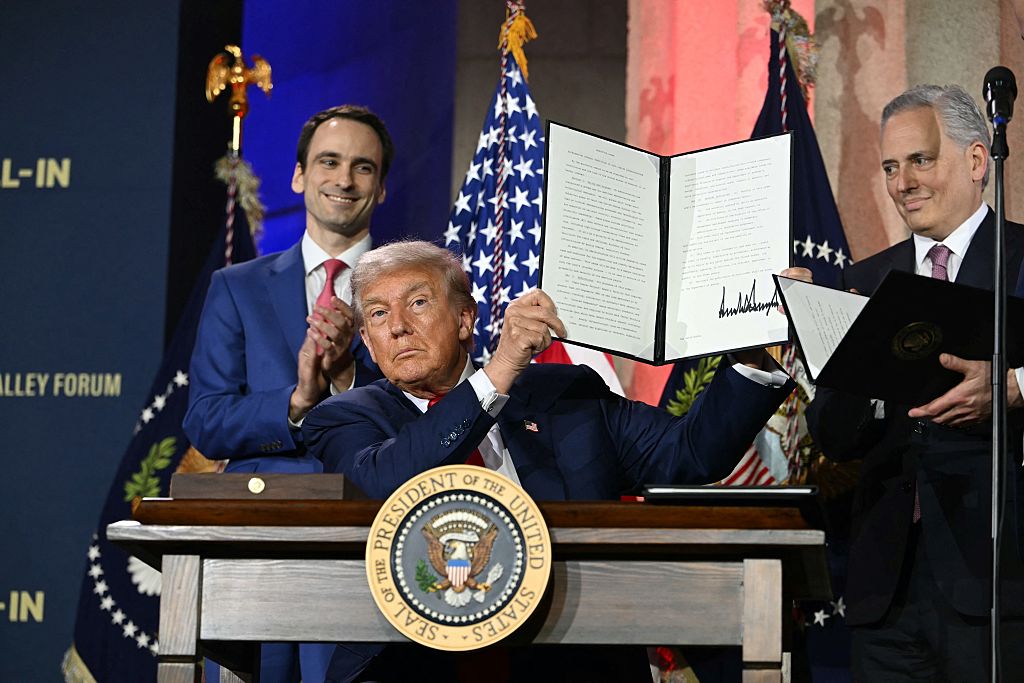
President Donald Trump signed an government order Thursday night that directs federal businesses to problem state AI legal guidelines, arguing that startups want aid from a “patchwork” of guidelines. Authorized consultants and startups in the meantime say the order may delay uncertainty, sparking court docket battles that go away younger firms navigating shifting state necessities whereas ready to see if Congress can agree on a single nationwide framework.
The order, titled “Guaranteeing a Nationwide Coverage Framework for Synthetic Intelligence,” directs the Division of Justice to arrange a activity power inside 30 days to problem sure state legal guidelines on the grounds that AI is interstate commerce and needs to be regulated federally. It provides the Commerce Division 90 days to compile a listing of “onerous” state AI legal guidelines, an evaluation that might have an effect on states’ eligibility for federal funds, together with broadband grants.
The order additionally asks the Federal Commerce Fee and Federal Communications Fee to discover federal requirements that might preempt state guidelines and instructs the administration to work with Congress on a uniform AI legislation.
The order lands amid a broader push to rein in state-by-state AI guidelines after efforts in Congress to pause state regulation stalled. Lawmakers in each events have argued that and not using a federal normal, blocking states from appearing may go away customers uncovered and firms largely unchecked.
“This David Sacks-led government order is a present for Silicon Valley oligarchs who’re utilizing their affect in Washington to protect themselves and their firms from accountability,” stated Michael Kleinman, head of U.S. Coverage on the Way forward for Life Institute, which focuses on decreasing excessive dangers from transformative applied sciences, in a press release.
Sacks, Trump’s AI and crypto coverage czar, has been a number one voice behind the administration’s AI preemption push.
Even supporters of a nationwide framework concede the order doesn’t create one. With state legal guidelines nonetheless enforceable except courts block them or states pause enforcement, startups may face an prolonged transition interval.
Techcrunch occasion
San Francisco
|
October 13-15, 2026
Sean Fitzpatrick, CEO of LexisNexis North America, U.Okay., and Eire, tells iinfoai that states will defend their client safety authority in court docket, with instances probably escalating to the Supreme Court docket.
Whereas supporters argue the order may cut back uncertainty by centralizing the struggle over AI regulation in Washington, critics say the authorized battles will create rapid headwinds for startups navigating conflicting state and federal calls for.
“As a result of startups are prioritizing innovation, they sometimes do not need … sturdy regulatory governance applications till they attain a scale that requires a program,” Hart Brown, principal writer of Oklahoma governor Kevin Stitt’s Process Power on AI and Rising Know-how suggestions, advised iinfoai. “These applications could be costly and time-consuming to satisfy a really dynamic regulatory setting.”
Arul Nigam, co-founder at Circuit Breaker Labs, a startup that performs red-teaming for conversational and psychological well being AI chatbots, echoed these issues.
“There’s uncertainty when it comes to, do [AI companion and chatbot companies] should self-regulate?” Nigam advised iinfoai, noting that the patchwork of state AI legal guidelines does harm smaller startups in his area. “Are there open supply requirements they need to adhere to? Ought to they proceed constructing?”
He added that he’s hopeful Congress can transfer extra rapidly now to move a stronger federal framework.
Andrew Gamino-Cheong, CTO and co-founder of AI governance firm Trustible, advised iinfoai the EO will backfire on AI innovation and pro-AI targets: “Large Tech and the large AI startups have the funds to rent legal professionals to assist them work out what to do, or they will merely hedge their bets. The uncertainty does harm startups probably the most, particularly these that may’t get billions of funding nearly at will,” he stated.
He added that authorized ambiguity makes it tougher to promote to risk-sensitive clients like authorized groups, monetary corporations, and healthcare organizations, rising gross sales cycles, techniques work, and insurance coverage prices. “Even the notion that AI is unregulated will cut back belief in AI,” which is already low and threatens adoption, Gamino-Cheong stated.
Gary Kibel, a accomplice at Davis + Gilbert, stated companies would welcome a single nationwide normal, however “an government order isn’t essentially the correct car to override legal guidelines that states have duly enacted.” He warned that the present uncertainty leaves open two extremes: extremely restrictive guidelines or no motion in any respect, both of which may create a “Wild West” that favors Large Tech’s capability to soak up danger and wait issues out.
In the meantime, Morgan Reed, president of The App Affiliation, urged Congress to rapidly enact a “complete, focused, and risk-based nationwide AI framework. We will’t have a patchwork of state AI legal guidelines, and a prolonged court docket struggle over the constitutionality of an Government Order isn’t any higher.”

